

Can Anxiety Cause Physical Symptoms Like Racing Heart  Muscle Tension  or Shortness of Breath

Can Anxiety Cause Physical Symptoms Like Racing Heart, Muscle Tension, or Shortness of Breath?

Many people think that worry is just a cycle of negative thoughts. Mental stress has very real physical symptoms, like your heart racing and struggling to catch your breath. Your pain is valid. When danger is detected, your brain sends urgent signals through your nervous system. This triggers a quick physical response that can be very scary. Let’s see why this is the case.

The Built-In Alarm System

Your brain and body communicate all day long. To understand your pain, we have to look at your internal alarm. This is the body’s fight-or-flight response, doctors say.
This reflex kept humans safe from predators. Your brain assisted you by boosting your heart rate to ensure blood reached your outermost extremities. Visualize yourself darting from a savage animal. Your body tenses, preparing for protection or a swift getaway.

Why Normal Life Feels Dangerous

We may not need to run from predators anymore, but we still depend on that primitive alarm system in our brains. Your brain interprets modern stressors such as a demanding work project or an overdue bill as actual physical threats. Your brain believes you are in danger. It reacts by pumping stress hormones into your bloodstream. Your heart races and your stomach churns, even while sitting. Your body is always ready to run, creating constant, exhausting tension.

The Most Common Physical Signs of Anxiety

Stress feels different for every person. But many notice the same clear signs.

  • A Very Fast Heartbeat: Your heart may beat so hard and fast that it feels like a pounding drum in your chest.
  • Stiff and Sore Muscles: Anxiety often causes unconscious physical tension, such as clenching your jaw or stiffening your neck, which leads to chronic muscle aches.
  • Trouble Catching Your Breath: Your chest may tighten, causing you to take shallow breaths and leaving you feeling as though the room is devoid of air.
  • Upset Stomach and Nausea: Worry can make you sick to your stomach. You might lose your desire to eat.
  • Shaking and Sweating: You might sweat a lot in a cold room. Your hands might tremble.

When to Call a Regular Medical Doctor

Physical symptoms of stress, like a racing heart, can feel frightening, resembling a heart attack. But you need to see a primary care doctor first to exclude any underlying problems with your heart or lungs.
If your doctor has given you the all clear, you can safely turn your attention to your mental health and see if chronic anxiety is the cause of your discomfort. When you are upset, do you have a more painful chest? If you are healthy, then your pain is most likely due to anxiety.

Quick Ways to Calm Your Body Down

You can tell your body to stop being on high alert. You can tell your brain that you’re safe. Here are tricks to quickly calm your nervous system.

  • Take Deep Belly Breaths: Stop what you are doing. Breathe in slowly through your nose. Breathe out slowly through your mouth. Repeat this five times.
  • Splash Cold Water: Wash your face with freezing cold water. The sudden cold shock distracts your brain.
  • Squeeze and Release Muscles: Squeeze your toes tight for five seconds. Let them go loose. Move up to your legs.
  • Go for a Short Walk: A brisk walk burns off the extra adrenaline. It helps muscles stretch out.

How Elevation Behavioral Health and Wellness Can Help You

You do not have to live with a pounding heart every day. Mental health care can stop the pain. At Elevation Behavioral Health and Wellness in Laurel, Maryland, we help adults and teens find lasting relief through both in-person sessions and secure telepsychiatry. Our experienced provider, Deborah Nakato, CRNP-PMH, understands the profound physical toll of anxiety and offers highly personalized care, starting with a comprehensive psychiatric evaluation.
We offer safe psychiatric medication management to calm your nervous system. We also provide supportive psychotherapy. Therapy teaches you brand new ways to cope with daily stress. It builds up your emotional strength. Our evidence-based treatments bring lasting wellness.
Feeling scared? We can help you deserve calm. Get in touch with Elevation Behavioral Health and Wellness to embark on your healing journey today.

FAQs

Q. Does walking help lower physical stress?

Yes. A short, fast walk burns off extra stress chemicals in your blood. It also stretches out stiff muscles.

Q. Is pain from anxiety real?

Yes. The physical pain is very real. Brain signals trigger actual physical reactions throughout your body during moments of stress.
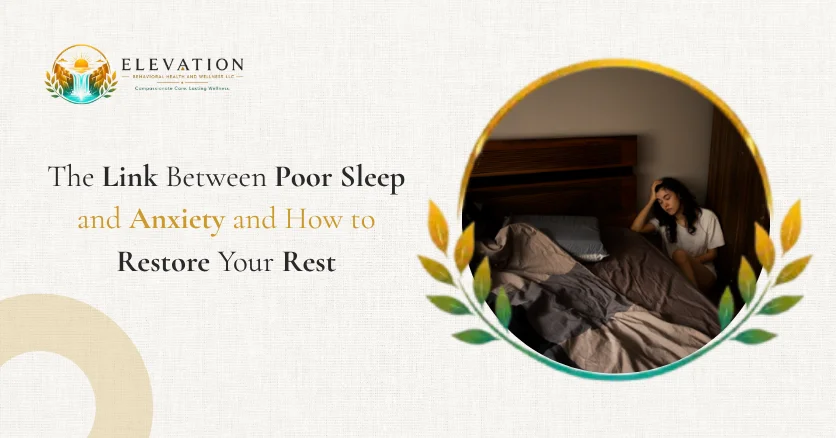
The Link Between Poor Sleep and Anxiety and How to Restore Your Rest

The Link Between Poor Sleep and Anxiety and How to Restore Your Rest

Ask someone with anxiety when the sleep problems started and most of them cannot give you a clean answer. It sort of crept in. First it was hard to fall asleep. Then the waking at 3am started. Then the dreading bedtime because they already knew what the night was going to look like. At some point it stopped feeling like a sleep problem on top of anxiety and started feeling like one continuous thing they could not separate.
That is because it basically is.

The Loop and Why It Is So Hard to Break

Anxiety keeps the nervous system on. That is what it does. The brain reads something as a threat, real or constructed, and the body goes into a state of readiness. Slightly elevated heart rate. Muscles that will not fully release. A mind that keeps scanning and reviewing and preparing for things that have not happened yet.
Sleep needs the opposite of all of that. It needs the nervous system to stand down, to trust that nothing requires managing for the next several hours, to let go of the vigilance that anxiety runs on. Lying down anxious and trying to fall asleep is like pressing the gas and brake at the same time. One of them is going to win and most nights it is not sleep.
Then the missed sleep does its own damage. Cortisol rises. Emotional reactivity goes up. The part of the brain that talks anxious thoughts down from the ledge, the prefrontal cortex, runs worse on poor sleep than almost anything else. So the person wakes up already more anxious than they went to bed, which makes the next night harder, which raises anxiety further. The loop does not need any outside help once it gets going.

Why the Hours Do Not Tell the Whole Story

Sleep is not a single state. The brain cycles through different stages across the night and each one is doing something specific. There is the lighter sleep that the body moves through on the way to deeper stages, the slow wave sleep where genuine physical restoration happens, and REM where the brain processes emotional experience from the day.

Anxiety tends to keep people in the shallower end of this. Less time in slow wave, disrupted REM, more frequent partial wakings that the person sometimes notices and sometimes does not. The result is someone who technically slept seven hours and wakes up feeling like they barely touched the mattress. The hours were there. The depth was not.
The REM piece matters more than people realize. When that stage gets cut short night after night, the brain is carrying unprocessed emotional content from the previous day into the next one. It is already behind before anything new happens. This is part of why anxiety tends to feel cumulative, why a small thing on a Thursday can feel enormous in a way it would not have on a Monday after better sleep.

The 3 am Problem

Waking in the middle of the night with the mind already running is one of the most common things anxious people describe. There is a reason it happens at that hour specifically.
Cortisol has a daily rhythm, is lowest at night and increases toward morning to help the body wake up. It’s a rhythm that is frequently disrupted in individuals who are chronically stressed and anxious. When cortisol goes up too early, when it shouldn’t be up, in the middle of what is supposed to still be sleep, and the person wakes up with the anxious mind already on the job before they’re even up and around. At that time, the thoughts are huge. The problems appear unsolvable. What seemed manageable yesterday doesn’t anymore.
It is not a reflection of how serious the problems actually are. It is a brain running on a cortisol spike at 3am doing what brains do in that state, which is catastrophize. The thoughts are not more accurate at that hour. They are just louder.

The Things That Make It Worse Without People Realizing

Alcohol before bed feels like it helps because it takes the edge off and makes falling asleep easier. It does not help. It suppresses the deeper sleep stages and causes the brain to rebound into a lighter, more fragmented state in the second half of the night. The person who drank to sleep often wakes at 3 or 4am with the anxiety back at full volume and no sedation left. This pattern is extremely common and almost never recognized as alcohol-related.
Late night screens are a problem less because of blue light and more because of what the content does to the brain. News, social media, anything that requires the evaluative mind to engage and react keeps the nervous system in exactly the state that sleep needs it out of. The winding down has to actually happen in the brain, not just in the body lying still in a dark room.
When sleep timing is inconsistent, then the entire system is disturbed. The body operates according to a circadian rhythm, some of which is dependent on consistency. Staying up two or three hours later on weekends and sleeping in to compensate shifts the rhythm enough that Sunday night becomes genuinely difficult. The person is unable to go to sleep at their normal bedtime, as the body doesn’t believe it is bedtime. Monday starts in deficit.

What Genuinely Helps

Getting up at the same time every morning regardless of how the night went is one of the more effective things a person can do and one of the harder ones to sell because it sounds counterproductive when exhausted. The consistent wake time builds sleep pressure that makes the following night easier. The rhythm stabilizes around it over time.
Getting out of bed when the mind will not settle is better than staying in it and fighting. When the bed becomes the place where the anxiety happens, the brain starts associating the two. Moving somewhere dim, doing something genuinely unstimulating until drowsiness comes back, and then returning interrupts that association. It does not feel like progress in the moment but it works.
Addressing the anxiety directly rather than only working on sleep habits. This is the part most sleep advice leaves out because it is not as clean as a bedtime routine. Sleep hygiene helps at the edges. When anxiety is running the show, the nervous system needs actual support for the anxiety itself. Therapy, medication where appropriate, or both. The sleep tends to follow when the anxiety gets properly addressed rather than the other way around.

When Self-Management Is Not Enough

Some people manage to chip away at this with the right adjustments. Others have been in the loop long enough that it has its own momentum and something more structured is needed.
If sleep has not felt restorative in months, if the anxiety is affecting work or relationships or just the basic experience of getting through a day, that is not a personality issue or a willpower issue. It is a clinical one. Treating it that way is not dramatic. It is just accurate.

Deborah Nakato, CRNP-PMH at Elevation Behavioral Health and Wellness in Laurel, Maryland has close to a decade of psychiatric experience across inpatient, crisis, community, and outpatient settings. Sleep disruption and anxiety together is one of the more common presentations she works with, and the approach here looks at both rather than handing one piece off while ignoring what is driving it.

Telepsychiatry available if coming in is not an option.

elevationbehavioralhealthandwellness.com or (240) 389-3706.
 3203 Fluvial Lane, Suite 303A, Laurel MD 20724.